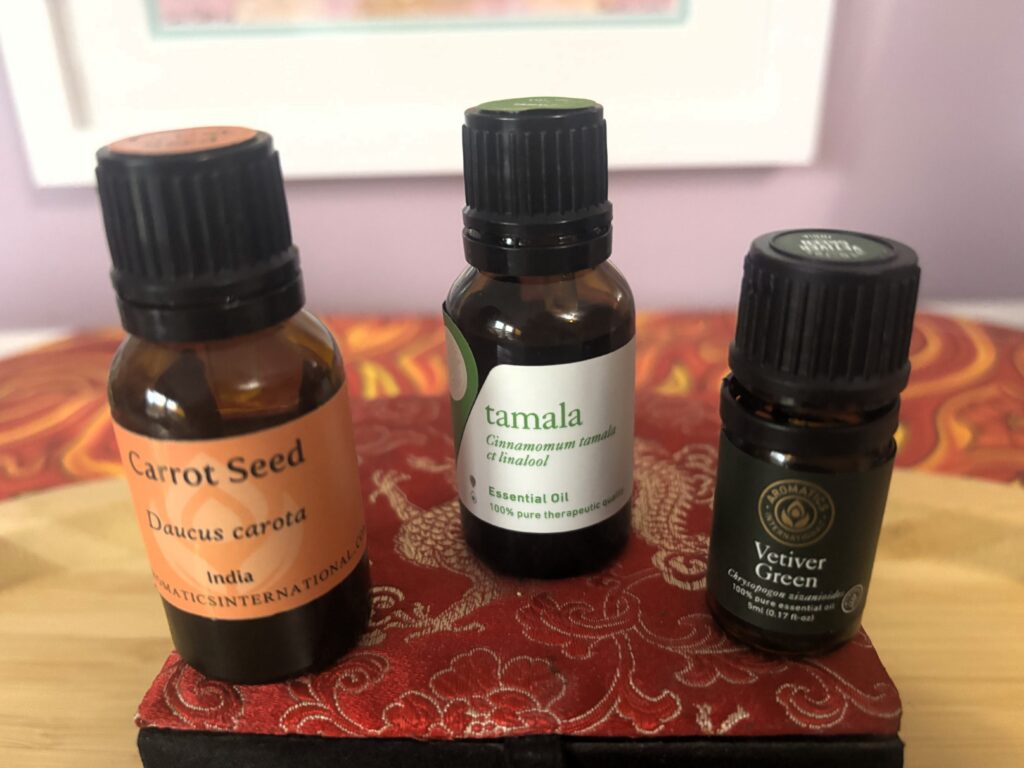

Following the Plants: Carrot Seed, Tamala & Green Vetiver
Exploring three essential oils and the inspiration behind The Rooted Evening collection Over the past several weeks, I’ve been…
Read More

Posted by Dorine King on November 2nd, 2026 in Aromatherapy, Aromatherapy Education, Following the Plants, The Enchanted Atelier
Over the past several weeks, I’ve been spending time getting to know three fascinating essential oils: Carrot Seed, Tamala, and Green Vetiver.
As part of my continuing aromatherapy education, I’ve been studying their chemistry, therapeutic properties, aromas, and blending possibilities. Along the way, I’ve also been experimenting with these oils in a collection of aromatic products for The Enchanted Atelier, which I’ve named The Rooted Evening.
Each oil brings something different to the collection. Carrot Seed offers an earthy warmth and an affinity for skin care. Tamala contributes a beautiful, sweet spiciness, while Green Vetiver brings a grounding, tranquil quality.
Now that the collection is coming together, I thought it would be fun to share a little of what I’ve been learning about each of these remarkable plants.
Let’s begin with Carrot Seed essential oil.
One of the first things we learn in aromatherapy is the importance of botanical names. Why do we use Latin names? Because common names can be confusing, and accurate botanical identification helps us understand which plant we’re working with, its chemistry, appropriate uses, and safety considerations.
Carrot Seed essential oil, Daucus carota, is distilled from the seeds of the carrot plant. Its aroma is earthy, warm, slightly sweet, and wonderfully distinctive.
In Aromatree, Salvatore Battaglia explores the chemistry and energetic qualities of seed oils. Carrot Seed contains several aromatic constituents, including alpha-pinene, beta-pinene, limonene, and carotol.
Carotol, a sesquiterpene alcohol, is one of the characteristic constituents of Carrot Seed essential oil.
Jade Shutes and Amy Galper, in The Ultimate Guide to Aromatherapy, also discuss carotol in connection with Carrot Seed’s reputation for supporting skin regeneration.
One of Carrot Seed’s most appreciated uses in aromatherapy is skin care, particularly in preparations intended for mature, tired, or delicate skin.
Battaglia describes it as rejuvenating and revitalizing for dull and tired-looking skin. Aromatics International also highlights its use in formulations for sensitive or mature skin.
Carrot Seed is frequently incorporated into facial oils, creams, lotions, and massage blends.
Beyond skin care, Battaglia describes seed oils as invigorating and fortifying. In his discussion of the psyche of seed oils, he also explores their symbolic relationship with digestion, processing experiences, and releasing pent-up emotions.
I find these connections between the physical plant, its aromatic chemistry, and its traditional energetic associations particularly interesting.
Carrot Seed pairs beautifully with many essential oils, including Lavender, Geranium, Grapefruit, Frankincense, Helichrysum, and Sandalwood.
Its earthy character can add depth and warmth to a blend, especially when combined with brighter citrus or floral aromas.
Safety note: Carrot Seed essential oil should be avoided during pregnancy and breastfeeding, according to Robert Tisserand and Rodney Young in Essential Oil Safety, second edition.
If Carrot Seed brings earthy warmth to the collection, Green Vetiver brings a sense of stillness.
Vetiver has long been one of the essential oils associated with grounding and tranquility. Its nickname, the “Oil of Tranquility,” seems particularly fitting.
Green Vetiver is a lighter, fresher aromatic expression of Vetiver. While traditional Vetiver can be deep, smoky, and intensely earthy, Green Vetiver has a greener, grassy, and somewhat cleaner character.
It is still a base note, however, and adds depth and staying power to aromatic blends.
Vetiver essential oil is distilled from the roots of a grass, and I find that particularly fascinating.
In Aromatree, Salvatore Battaglia discusses the symbolic qualities of roots and their relationship to stability, nourishment, resilience, and our capacity to thrive.
Roots anchor a plant in the earth, absorb nourishment, and support new growth.
What a lovely metaphor for our own need to feel grounded, supported, and restored.
Battaglia describes root oils as comforting, nurturing, and restorative to the nervous system within traditional aromatic practice.
Vetiver has a complex chemistry, rich in sesquiterpenes and sesquiterpene alcohols.
Aromatics International describes Green Vetiver as useful in skin care formulations and aromatic blends intended to encourage relaxation and emotional balance.
In Scent and Psyche, Peter and Kate Damian discuss Vetiver’s traditional use in massage, baths, and lotions, as well as its associations with nervous exhaustion, physical discomfort, and emotional steadiness.
I’ve also come across Vetiver in several aromatherapy texts discussing grief, tension, and difficult emotional experiences.
Kurt Schnaubelt mentions Vetiver among calming essential oils in The Healing Intelligence of Essential Oils, while Jade Shutes and Amy Galper include it in blends developed around emotional support.
Although these traditional applications are interesting, they shouldn’t be confused with established medical treatments. What especially interests me is Vetiver’s aromatic ability to create an atmosphere that feels quiet, steady, and comforting.
Vetiver blends beautifully with Frankincense, Geranium, Grapefruit, Jasmine, Lavender, Sandalwood, and Ylang-Ylang.
Because its aroma can be quite persistent, a small amount often goes a long way.
For The Rooted Evening, I especially appreciate the way Green Vetiver anchors the other two oils.
And then there’s Tamala!
Of these three essential oils, Tamala is perhaps the one that surprised me the most.
I was introduced to Tamala through an aromatherapy class, and I fell in love with its aroma almost immediately.
Tamala, sometimes called Indian Bay Leaf, comes from a tree in the cinnamon family. Its aromatic character is warm, spicy, sweet, and wonderfully radiant.
Aromatics International describes Tamala as a middle-to-base note that contributes warmth and body to a blend.
For me, it adds a beautiful softness and richness to the more earthy qualities of Carrot Seed and Green Vetiver.
One of the things I enjoy most about studying essential oils is discovering how their chemistry helps explain their aromatic character and potential applications.
The particular batch of Tamala I’m working with contains 32.71% linalool, according to its chemical analysis.
Linalool is a monoterpene alcohol found in many essential oils and is frequently studied for its calming aromatic properties.
Tamala may also contain 1,8-cineole, a constituent often discussed in aromatherapy in connection with respiratory comfort.
Of course, the chemistry of an essential oil can vary from batch to batch, which is another reason I appreciate having access to chemical analyses of the oils I’m using.
Compared with Carrot Seed and Vetiver, I’ve found fewer detailed discussions of Tamala in my aromatherapy reference books.
Much of my initial information has come from Aromatics International and Aromahead Institute, where I was introduced to this oil.
Its warm, sweet-spicy character makes it especially appealing in aromatic blends intended to create a comforting atmosphere.
I am looking forward to studying Tamala in greater depth. When a class devoted to this oil becomes available, I’ll certainly be taking that class!
Safety note: Tamala essential oil deserves careful attention to its particular chemical composition and appropriate dilution. As a precaution, I avoid recommending it during pregnancy or breastfeeding.
So, what happens when we bring Carrot Seed, Tamala, and Green Vetiver together?
For me, they create a lovely aromatic relationship.
Carrot Seed contributes earthy warmth and its traditional affinity for skin care.
Tamala adds a sweet, spicy richness that brings the other aromas together.
Green Vetiver provides a deep, grounding foundation and a sense of tranquility.
Together, these three oils became the inspiration for The Rooted Evening, my October collection for The Enchanted Atelier.
Throughout the month, I’ve been exploring their possibilities in bath, body, facial, and diffuser preparations, including Still Waters Bath Salts, Evening Veil Body Cream, Clear the Day Facial Cleanser, Quiet Mist Facial Toner, Deep Roots Facial Serum, Night Garden Face Cream, and an Evening Diffuser Blend.
Each preparation has given me another opportunity to learn about the oils, their aromas, and how they work together in a finished formulation.
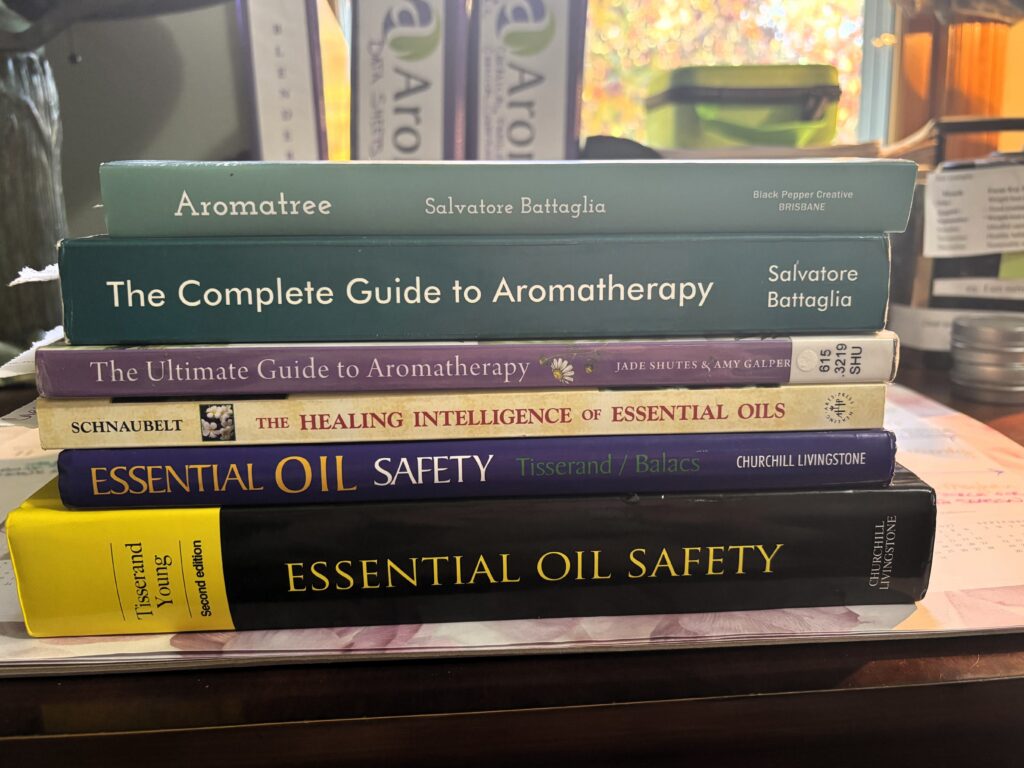
Some of my favorite aromatherapy references — always something new to learn!
One of the things I love about aromatherapy is that there’s always more to discover.
Studying an essential oil isn’t simply about learning its botanical name, chemical constituents, or therapeutic traditions. It’s also about getting to know the plant, appreciating its aroma, understanding its safety considerations, and discovering how it can become part of a thoughtful aromatic practice.
This little journey with Carrot Seed, Tamala, and Green Vetiver has been a wonderful addition to my continuing aromatherapy education.
And while The Rooted Evening collection brings this particular exploration to a close, I’m certainly still learning about these three oils.
There will always be another plant to study, another aromatic discovery, and another opportunity to blend.
#FollowingThePlants
References and further reading
This article shares my personal aromatherapy studies and experiences. References to traditional therapeutic uses are educational and are not intended as medical advice. Essential oils should be used with appropriate dilution and attention to individual safety considerations.


Exploring three essential oils and the inspiration behind The Rooted Evening collection Over the past several weeks, I’ve been…
Read More
Finding Balance Beneath the Full Hunter’s Moon Why does losing weight seem to be such a battle for some people…
Read More
For years, I have known that sleep is something I need to take seriously. Today, my blog is about sleep,…
Read More